Better forecasts. Less manual work.
A more accurate, stable and explainable baseline forecast for demand planning teams. Built, run and continuously improved by our team. Delivered into the planning systems you already use.
Lower inventory. Fewer stockouts. More time for planners to focus on exceptions.


When the baseline falls short, planners fill the gap. They clean history, adjust forecasts and review thousands of SKUs every cycle.
As demand patterns shift and working capital comes under pressure, the cost of an unreliable baseline becomes harder to absorb.

Hours spent preparing data, correcting forecasts and making manual adjustments instead of managing exceptions.

Forecasts change without clear explanations, leaving planners unsure which numbers to trust or adjust.

Stockouts and supply disruptions distort demand history, while traditional forecasts often overlook promotions, external signals and other demand drivers.
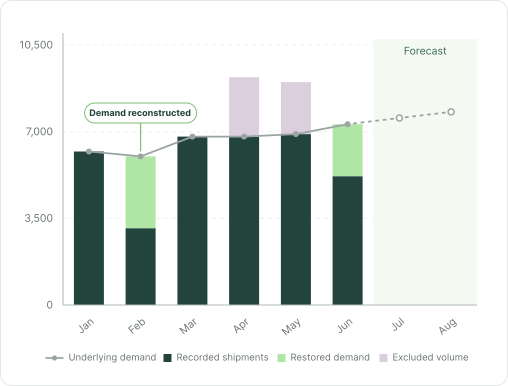
Reconstruct underlying demand by correcting distortions such as stockouts, pull-forwards and re-pipes. Match the forecasting approach to each demand pattern, including new products, long-tail items and promotions.
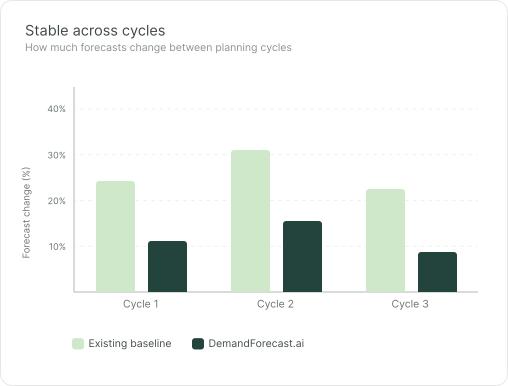
Reduce unnecessary changes between planning cycles while responding to meaningful shifts in demand.
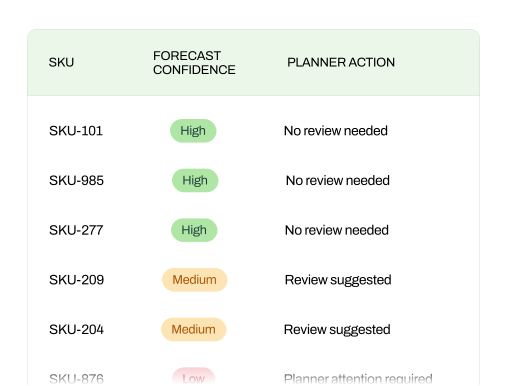
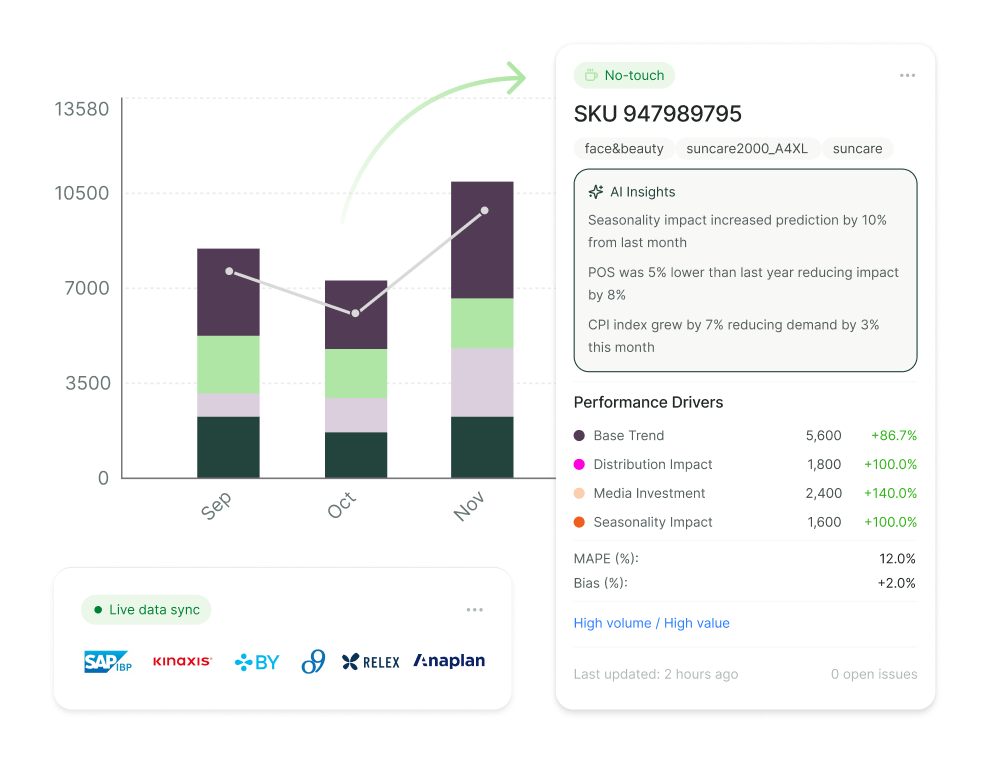
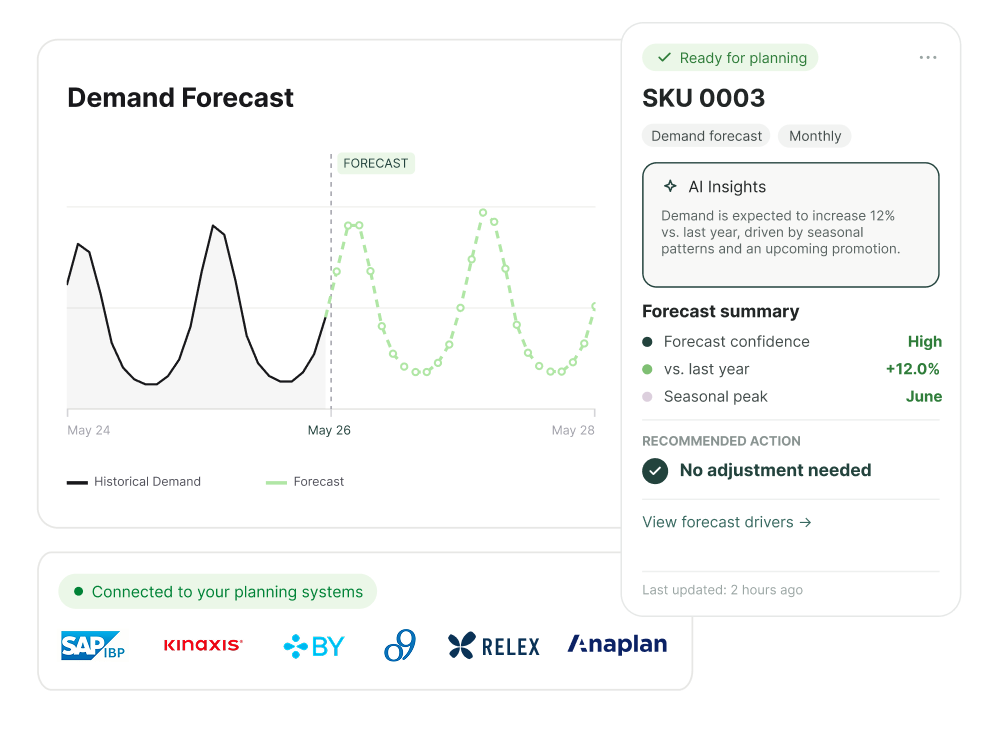
Confidence and predictability signals help planners identify forecasts that can run untouched and focus their judgment where it can improve the outcome.
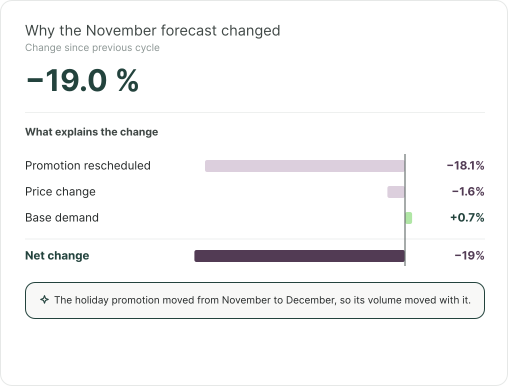
AI-powered explanations show what drives the forecast, what changed since the previous cycle and why, in planner terms.
Reconstruct underlying demand by correcting distortions such as stockouts, pull-forwards and re-pipes. Match the forecasting approach to each demand pattern, including new products, long-tail items and promotions.
Reduce unnecessary changes between planning cycles while responding to meaningful shifts in demand.
Confidence and predictability signals help planners identify forecasts that can run untouched and focus their judgment where it can improve the outcome.
AI-powered explanations show what drives the forecast, what changed since the previous cycle and why, in planner terms.
Your team keeps its planning systems and judgment. We manage the forecasting process and continuously improve performance.
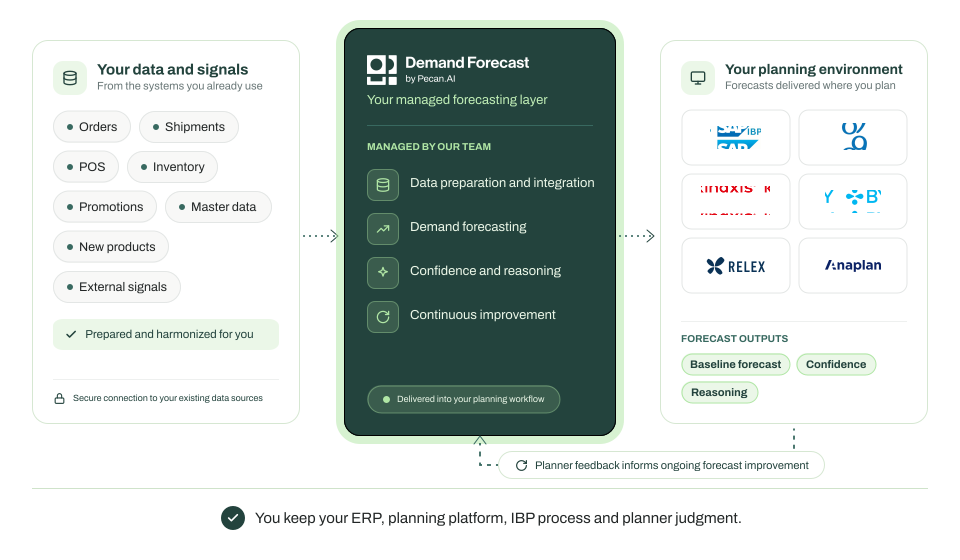
Our team manages and continuously improves your forecasts, giving you dedicated forecasting expertise without the need to build or maintain it in-house.
Traditional demand forecasting is struggles with the complexity and speed of modern supply chains.


The Predictive GenAI framework is truly a game changer in making machine learning and AI capabilities accessible to the business team.


Demand Forecast proved value quickly. Within a month, forecasts surpassed our prior process without manual cleanup, letting planners focus on strategy, not firefighting.

average reduction in forecast error
less manual planning effort
of forecast volume managed without manual edits
less overstock in a customer deployment