From complex demand data to better planning decisions.
See how DemandForecast.ai reconstructs underlying demand, builds more accurate and stable forecasts, and helps planners focus where their judgment adds value.
See the full picture of demand.
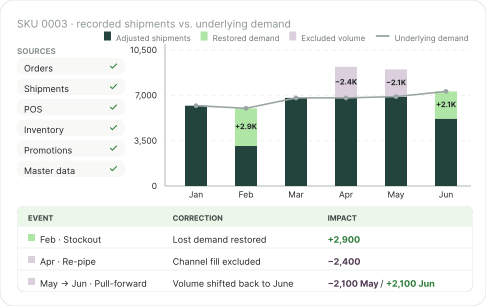
Bring together historical sales, business inputs and external signals, then correct distortions in demand history to reveal underlying demand.
Data connectivity: Connect orders, shipments, POS, inventory, promotions and external data through your existing systems or data warehouse.
Data preparation: Clean and harmonize data across sources and systems.
Multivariate & cross-SKU learning: Learn across demand signals, related products and product hierarchies, incorporating promotions and other demand drivers when available.
Demand reconstruction: Correct for stockouts, re-pipes, pull-forwards and anomalies to estimate underlying demand.
A stronger forecast, without unnecessary swings.
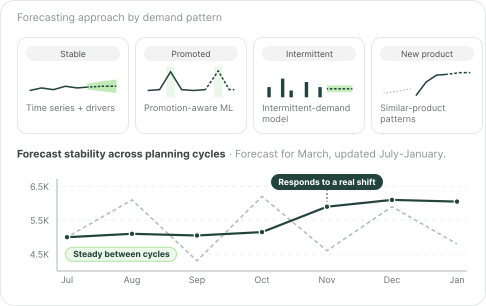
A stable best-seller, a promoted item and an intermittent SKU need different forecasting approaches. DemandForecast.ai matches the approach to each pattern.
Adaptive forecasting: Combine machine learning and time-series approaches suited to different demand patterns.
Forecast stabilization: Reduce unnecessary changes while responding to meaningful demand shifts.
Flexible planning horizons: Support short and long-term forecasting needs.
Put planner time where it adds value.
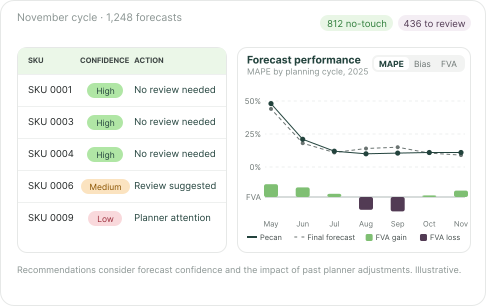
Not every forecast needs manual review. DemandForecast.ai helps planners focus on exceptions and decisions where their input can improve outcomes.
Confidence signals: Understand which forecasts are reliable and which need closer attention.
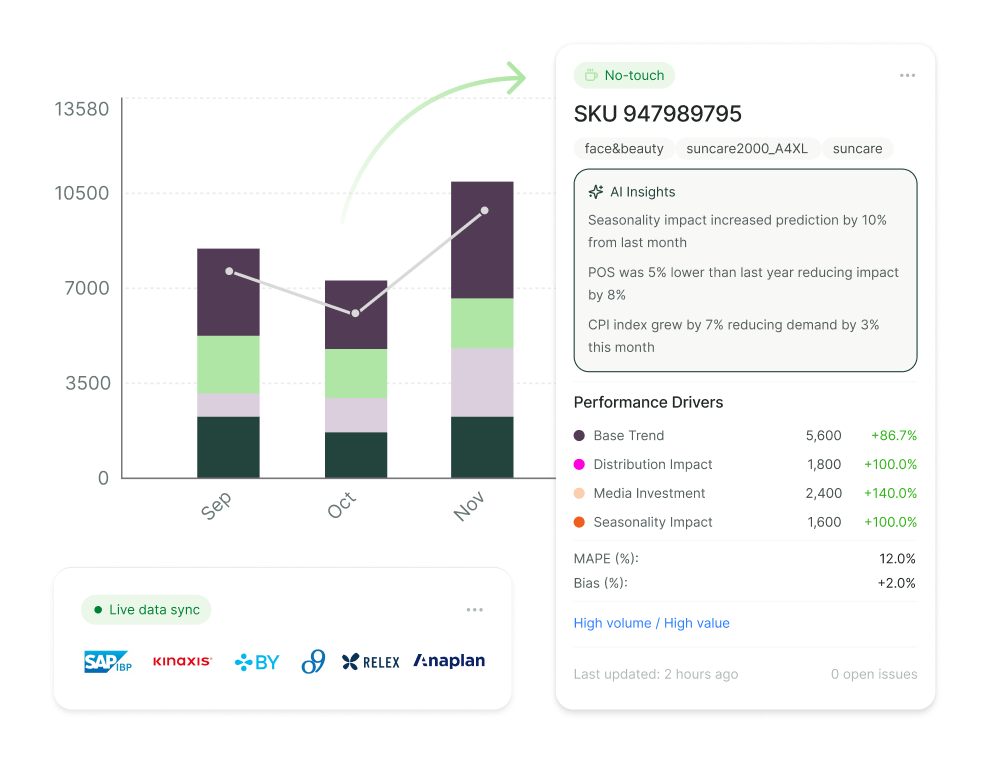
No-touch forecasting: Identify forecasts that can run without manual adjustments.
Forecast Value Added (FVA): Monitor where planner adjustments improve accuracy and use those insights to guide future interventions.
Understand what drives the number.
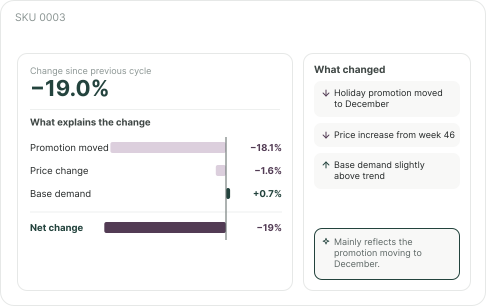
Get clear, AI-powered explanations of forecast performance and changes, so planners can make informed decisions with confidence.
Demand drivers: See which factors influence the forecast.
Cycle-to-cycle changes: Understand what changed since the previous planning cycle and why.
Portfolio context: Explore seasonality, YoY growth, lifecycle changes and risks across products.
A continuously improved forecast, built into your workflow.
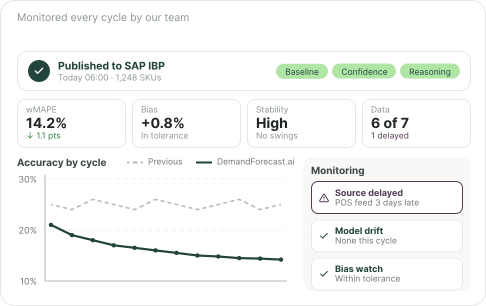
Get forecasts delivered into your existing planning systems, with ongoing monitoring and improvements managed by our team.
Forecast delivery: Deliver forecasts, confidence signals and explanations into SAP IBP, o9, Kinaxis, Blue Yonder or in-house planning tools.
Ongoing monitoring: Track accuracy, bias and drift as demand changes.
Continuous improvement: Incorporate valuable planner feedback to improve future forecasts.
Your team provides business context and planner judgment. We maintain the forecasting capability.
Built for real-world demand complexity.
New-product forecasting
Build initial forecasts using similar products, account for launch pipe fill, and refine the forecast as actual sales arrive.
Product lifecycle management
Handle phase-ins, phase-outs, replacements and discontinued products.
Intermittent and long-tail demand
Apply approaches suited to sparse and irregular purchasing patterns.
Promotions and events
Account for promotions, limited-time offers and one-off events that affect demand.
Business-calendar awareness
Account for holidays, trading days and calendar shifts.
Hierarchical forecasting
Support different product and planning levels, including top-down allocation where appropriate.
Company size
Enterprise
Industry
Consumer products
“
The Predictive GenAI framework is truly a game changer in making machine learning and AI capabilities accessible to the business team.
Neil Ackerman
Head, Worldwide Innovation and Disruption,
Global Consumer Supply Chain
Company size
Enterprise
Industry
Automotive
“
Demand Forecast proved value quickly. Within a month, forecasts surpassed our prior process without manual cleanup, letting planners focus on strategy, not firefighting.